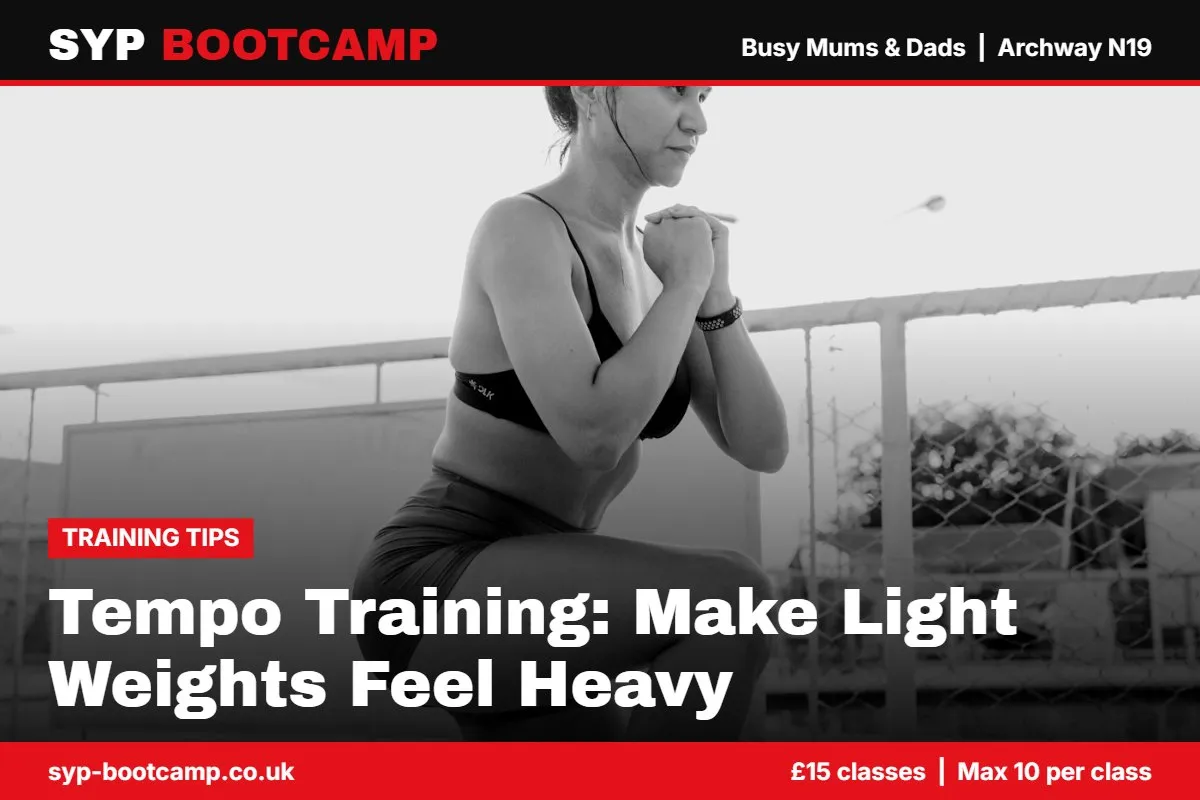
Tempo Training: Make Light Weights Feel Heavy
Here is a common home workout problem. You bought a pair of 5 kg dumbbells during lockdown. They felt heavy then. Now you can do 20 squats with them while thinking about the shopping list. Buying a whole rack of heavier weights is not happening, and there is no room for it anyway. The answer is tempo training: slowing your reps down on purpose so light weights feel heavy again.
I use tempo with nearly everyone I coach, from new mums with a single kettlebell to dads who have lifted for years. It costs nothing, takes up no space, and it is one of the best ways to build strength and control at home.
What is tempo training?
Tempo training means controlling how many seconds each part of a rep takes. Instead of bouncing up and down, you move at a set speed. That keeps your muscles working for longer in each set (often called “time under tension”), it makes you control the weight, and it shows up weak spots in your technique.
How to read a tempo code
You will often see tempo written as three or four numbers, like 3-1-1-0. Each number is seconds:
- First number: the lowering part (going down in a squat, lowering in a push-up).
- Second number: the pause at the bottom.
- Third number: the lifting part (standing up, pushing up).
- Fourth number: the pause at the top.
So a squat at 3-1-1-0 means: 3 seconds down, 1 second pause at the bottom, 1 second up, straight into the next rep. Some plans use an “X” for the lifting part, which means “as fast as you can with control”.
Why slow reps work so well at home
- It makes light weights harder. A 10-rep set at normal speed might take 15 seconds. At 4-1-1-0 it takes about 60 seconds. Same weight, very different challenge.
- It improves technique. You cannot cheat with momentum, so you learn to own every position.
- It is kind on joints. Slow, controlled lowering with lighter loads suits people coming back after a break, as long as nothing hurts.
- It is quiet. No jumping, no crashing weights. Perfect for training after bedtime in a flat.
A 25-minute tempo training workout
All you need is a pair of light dumbbells, a kettlebell, or even just your bodyweight. Warm up for 5 minutes first with marching, arm circles and a few easy squats.
Do 3 rounds. Rest 45 to 60 seconds between exercises and 90 seconds between rounds.
- Goblet or bodyweight squat, tempo 4-1-1-0, 8 reps. Count four slow seconds down, pause, stand up smoothly.
- Push-up (worktop, sofa arm or floor), tempo 3-1-1-0, 6 to 10 reps. Lower slowly, pause just above the surface, press up. My push-up progression for beginners helps you pick the right height.
- Romanian deadlift, tempo 3-1-1-1, 8 reps. Three seconds down to below the knee, pause, stand, squeeze your glutes for a second at the top.
- Split squat, tempo 3-0-1-0, 6 to 8 each leg. Hold a chair for balance if needed.
- Single-arm row, tempo 1-0-3-1, 8 each arm. This one is reversed: pull quickly, hold at the top for 1, then lower for 3 seconds.
- Glute bridge, tempo 2-0-1-3, 10 reps. Lift, then hold at the top for 3 seconds before lowering for 2.
Count out loud at first. Most people speed up without noticing, especially on the last few reps.
How to progress your slow reps
Tempo is a form of progressive overload, so you can build on it week by week:
- Week 1 to 2: 3-second lowering, 1-second pause.
- Week 3 to 4: 4-second lowering, 2-second pause.
- Week 5 to 6: add a rep or two to each set, or add a fourth round.
- After that: try harder variations, such as feet-elevated push-ups or rear-foot elevated split squats, or a slightly heavier weight at a normal tempo.
Who should be careful
Slow reps are generally gentle, but long pauses under load can tempt you to hold your breath. Keep breathing throughout: in on the way down, out on the way up. If you have high blood pressure or a heart condition, avoid holding your breath and straining, and check with your GP before starting a new strength routine. The same applies if you are pregnant, recently postnatal, or recovering from an injury. Stop if anything hurts sharply.
Slow reps in my classes
In SYP Bootcamp, we often use tempo on the first strength block, so everyone gets good at the movement before we speed things up. With no more than 10 people in the room, I can count with you and spot anyone rushing. The SYP Built To Last functional strength class uses tempo a lot, because controlled strength is what keeps joints happy as we get older. If you are training at home with no kit at all, try adding tempo to my no equipment home workout.
FAQs
Are slow reps good for building muscle?
Yes, it can be. Slower reps keep your muscles working for longer and let you get a lot out of lighter weights. Like any training, it works best when you gradually make it harder over time.
What is a good tempo for beginners?
A 3-1-1-0 tempo is a great start for most exercises: 3 seconds down, 1-second pause, 1 second up. It is slow enough to build control without being exhausting.
Does slowing reps down burn more calories?
A slow set lasts longer, so it can feel more demanding, but the difference in energy used is not the main reason to do it. The real benefits are strength, control and better technique.
Can I use a tempo with bodyweight only?
Absolutely. Slow squats, push-ups, lunges and bridges are all much harder at a controlled tempo, which makes it ideal for home workouts with no equipment.
Book your first class
Want someone counting the seconds for you? SYP Bootcamp runs 45-minute small-group classes in a church hall in Archway N19, max 10 people, £15 a class, all fitness levels welcome. Book your £15 class here or call or WhatsApp me on 07301 512215. If you prefer to train at home with a plan and check-ins from me, my online coaching is built for exactly that.
About the author
Artem Olekhnovych is a personal trainer in Archway and the founder of SYP Fitness and SYP Bootcamp. He has coached clients in Archway, Highgate and across North London for over 10 years, and runs small-group bootcamp classes for busy mums and dads. Read reviews from his 1-1 clients.
