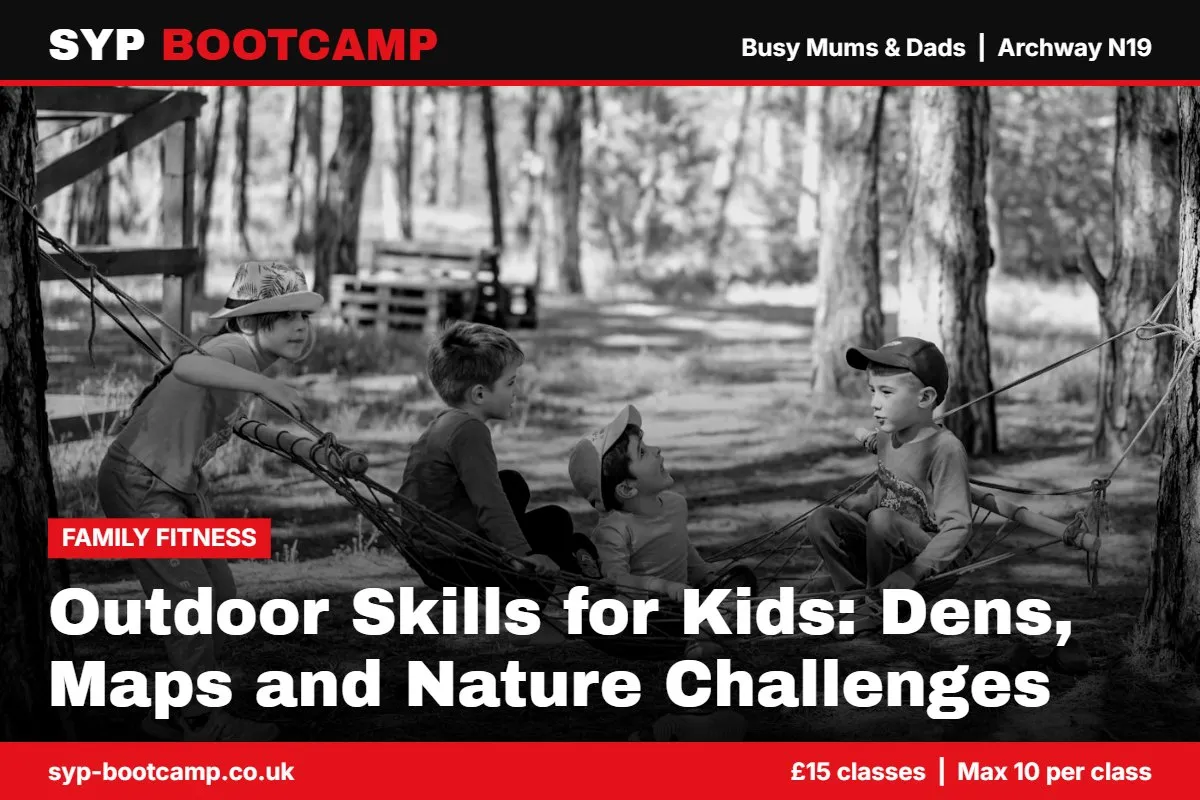
Outdoor Skills for Kids: Dens, Maps and Nature Challenges
Ask most kids to “go for a walk” and you get groans. Ask them to build a den that can survive the rain, find their way back to the car using a map they drew, or track a squirrel without it noticing, and suddenly they are off. Teaching outdoor skills for kids is one of the sneakiest ways to get them active, because the exercise is hidden inside an adventure.
I coach busy parents in Archway, and we are lucky up here. Highgate Wood, Queen’s Wood and the Parkland Walk are all within easy reach. You do not need a camping trip to the Lake District. A Saturday morning in the woods is enough to start.
Why outdoor skills for kids matter
Den building, map reading and nature challenges get children walking, climbing, carrying, crouching and balancing on uneven ground for hours without complaint. That counts towards the NHS recommendation of an average of at least 60 minutes of moderate or vigorous activity a day for children aged 5 to 18 (NHS activity guidelines for children).
The bigger win is confidence. A child who can read a simple map, use a whistle and build a shelter feels capable. That feeling carries into the playground and the classroom.
Skill 1: Den building
Den building is the gateway skill. It involves dragging branches, lifting, balancing and teamwork. Check the rules of your local woods first, use only fallen wood, and take the den apart before you leave so others can enjoy the space.
- Find a frame. A low, strong branch or two trees close together.
- Lay a ridge pole. One long fallen branch resting at an angle from the frame to the ground.
- Add the ribs. Lean shorter sticks along both sides of the ridge pole.
- Thatch it. Pile leaves and bracken on top, starting from the bottom.
- Test it. Can everyone fit? Does it stay up if someone taps it?
Challenge for older kids: build it in 20 minutes with a timer, or make it big enough for a parent.
Skill 2: Map reading
Start small and build up over a few trips.
- Ages 4 to 6: Draw a simple map of your garden or local playground together. Hide a toy and mark it with an X. They find it.
- Ages 6 to 8: Print a park map. Let them lead the way to the café or playground using landmarks: “turn left at the big oak”.
- Ages 8 to 12: Learn to orientate the map (turn it so it matches what you see) and try a simple compass. Set them a route with three checkpoints.
The Parkland Walk is ideal for first routes because it follows the line of an old railway, so it is hard to get badly lost. The Friends of the Parkland Walk access page shows the entrances.
Skill 3: Nature challenges
These keep kids moving and looking closely at the world.
- Tree hunt. Find five different leaves and match them to trees. Oak, hornbeam and holly are common in Highgate Wood. The City of London has a page on Highgate Wood wildlife to help you.
- Silent stalk. Creep up on a bird or squirrel as close as you can without it running. It is slow, low squatting work and excellent for leg strength.
- Stick bridge. Build a bridge over a small ditch or puddle strong enough to hold a pine cone.
- Colour palette. Find something in nature for every colour of the rainbow.
My outdoor scavenger hunt for kids turns this into a full printable game.
Skill 4: Safety basics every child should learn
- Stop and stay. If they get lost, they stay where they are and call out. Practise it.
- Whistle code. Three blasts means “help”. Give them a cheap whistle on a lanyard.
- Look but don’t eat. No berries or mushrooms in mouths, ever.
- Wash hands after touching soil and before snacks.
- Dress for it. Layers, waterproofs and boots with grip. Wet leaves are slippery.
A sample outdoor skills morning
Here is a two-hour plan for Highgate Wood or Queen’s Wood:
- Walk in and map warm-up (20 minutes). Kids lead using a printed map.
- Den build (40 minutes). In teams if you are with friends.
- Snack in the den (15 minutes).
- Nature challenge (30 minutes). Tree hunt and silent stalk.
- Take down the den and walk back (15 minutes). Kids navigate home.
For walking routes that fit around this, see my guide to family walks in North London.
What about the grown-ups?
Dragging branches and crouching in dens is surprisingly hard work. Many parents tell me they felt it in their back and thighs the next day. That is a sign your body needs a bit more strength and mobility for everyday life.
My SYP Bootcamp classes in Archway are built for exactly that: 45 minutes, small groups, practical strength. The SYP Built To Last functional strength class trains the lifting, carrying and squatting that family adventures demand.
FAQs
Which outdoor skills for kids should come first?
Start with staying safe (stop and stay, whistle code), then simple map reading and den building. These build confidence quickly and get them moving.
At what age can kids learn to read a map?
Children as young as four can follow a simple picture map. Most can use a real park map with help from around seven or eight, and a compass from about nine.
Is den building allowed in London parks and woods?
It varies. Some woods welcome it with fallen wood only, others ask you not to. Check the site’s rules or notice boards, never cut living trees, and dismantle your den before leaving.
How do I keep my kids interested in outdoor activities?
Give them a mission and a role, such as navigator, builder or wildlife spotter. Rotate the roles and bring a good snack.
Book your first class
If family adventures leave you puffing, let’s fix that. SYP Bootcamp runs 45-minute small-group classes indoors in a church hall in Archway N19, maximum 10 people, £15 a class, with easier and harder options for every exercise. Book my £15 class or call or WhatsApp me on 07301 512215 and I will send the timetable. If you live just down the road, I also offer one-to-one sessions as a personal trainer in Tufnell Park.
About the author
Artem Olekhnovych is a personal trainer in Archway and the founder of SYP Fitness and SYP Bootcamp. He has coached clients in Archway, Highgate and across North London for over 10 years, and runs small-group bootcamp classes for busy mums and dads. Read reviews from his 1-1 clients.
