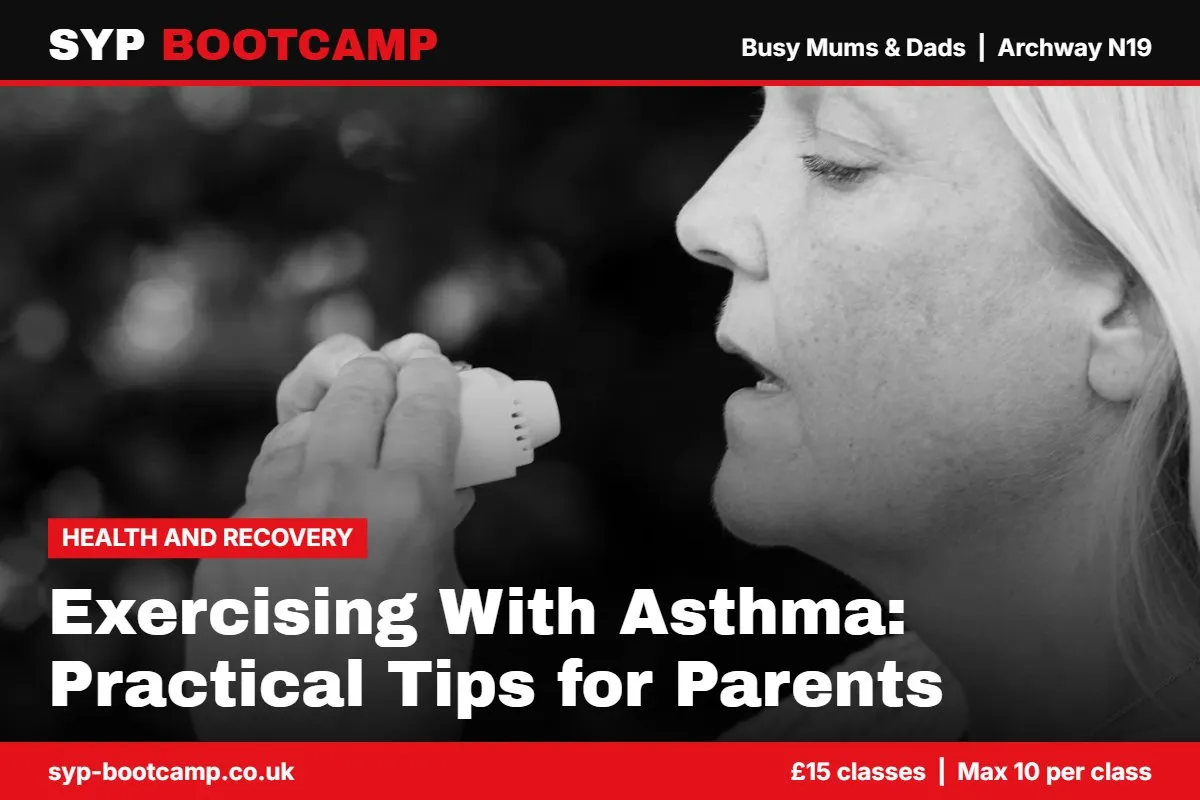
Exercising With Asthma: Practical Tips for Parents
You start a workout full of good intentions, and five minutes in your chest feels tight, you are coughing and you are wondering whether you should even be doing this. If you have asthma, it is easy to start avoiding exercise altogether, especially when you are already juggling work and kids. But the NHS recommends regular exercise for people with asthma, and with the right plan many people train comfortably. This guide covers general, NHS-based tips for exercising with asthma: getting your inhaler plan sorted, warming up well, coping with cold London air, and what to discuss with your GP or asthma nurse.
Exercising with asthma: start with your care team
The NHS page on asthma says regular exercise is recommended, and that if exercise triggers your symptoms you should ask a doctor or nurse how to exercise safely. That is the most important step in this whole post, so I will put it first.
Before you start a new exercise routine, book in with your GP or practice asthma nurse and ask about:
- Your asthma action plan. The NHS explains that this records how and when to use your medicines, how to avoid triggers and what to do if symptoms get worse. Ask for it to include exercise.
- Your inhaler technique. Lots of people use their inhaler slightly wrong for years. The annual asthma review is a good time to check.
- Whether to use your reliever before exercise. Some people are advised to, some are not. It depends on your medicines, so follow what your care team says rather than what a friend does.
- What level of exercise is sensible for you right now.
Asthma + Lung UK has a helpful page on when exercise triggers your asthma, which explains that taking your preventer every day as prescribed can lower the risk of exercise-triggered symptoms, and that your GP or nurse can review your treatment if exercise is a trigger.
My practical checklist for every session
These are the habits I ask anyone with asthma to build into their routine, once their GP or nurse is happy for them to exercise:
- Reliever inhaler with you, every time, within reach.
- Tell your coach. I want to know you have asthma, where your inhaler is, and what your action plan says.
- Take your preventer as prescribed, including on days you feel fine.
- Do not train when your asthma is flaring or you have a chest infection.
- Stop if you get wheezy, tight-chested or very breathless. Use your reliever as your plan says and do not restart until symptoms have fully settled.
Warm up longer than you think
A gradual warm-up gives your breathing time to adjust. Many people with asthma find they cope better with a slow build than with a sudden start. Here is a 10-minute warm-up I use:
- Minutes 0 to 3: easy marching or walking, nose breathing if you can
- Minutes 3 to 6: bodyweight squats, arm circles, walking lunges, all slow
- Minutes 6 to 8: brisker marching or step-ups, a little faster
- Minutes 8 to 10: two or three 20-second bursts at a moderate pace, with a minute easy in between
My post on how to warm up before exercise has more detail on why it matters.
A beginner-friendly session
Steady strength work with planned rests tends to be easier to manage than long, all-out cardio. Try this 25-minute session:
- 10-minute warm-up above
- 3 rounds, resting 60 to 90 seconds between exercises:
- Goblet squat or bodyweight squat, 10 reps
- Incline push-up, 8 to 10 reps
- Glute bridge, 12 reps
- Band or backpack row, 10 reps
- Step-ups on the bottom stair, 30 seconds
- 5-minute cool down: easy walking and gentle stretches, letting your breathing settle fully
If you want to add intervals later, keep the work bursts short and the rests generous. My low-impact HIIT post shows how to make intervals gentler.
Cold air, pollution and other triggers
The NHS lists cold air, exercise, air pollution, smoke, infections and allergens such as pollen, dust and mould among common asthma triggers. Asthma + Lung UK explains that when you breathe harder through your mouth, the air is not warmed or moistened as much, which can tighten airways in some people.
Practical ideas for London winters and busy roads:
- On cold days, try a loose scarf or snood over your nose and mouth during warm-up.
- Train indoors on very cold or high-pollution days.
- Choose park routes rather than main roads where you can. Around Archway, that might mean the Parkland Walk or Waterlow Park rather than the A1.
- Keep a simple symptom diary to spot patterns.
Colds are a common trigger too. My post on whether to exercise with a cold has some general guidance, but always follow your asthma action plan first.
When to get urgent help
The NHS says to call 999 during an asthma attack if your symptoms get worse, do not improve after the maximum dose of your reliever set out in your plan, or you do not have your inhaler. After any attack, get an urgent GP appointment, ideally within 2 days. See your GP if you need your inhaler more often than usual or your treatment is not helping.
Where a bootcamp class fits
With a maximum of 10 people, I can keep an eye on everyone, and you can take the easier option or an extra rest at any point. My classes are indoors, so you avoid cold, damp air and traffic fumes. Bring your inhaler, tell me about your asthma when you book, and we will work around you.
SYP Built To Last is a strength-focused class with built-in rest, which many people with asthma find more comfortable than nonstop cardio.
FAQs
Is it safe to exercise with asthma?
The NHS recommends regular exercise for people with asthma. If exercise triggers your symptoms, ask your GP or asthma nurse how to exercise safely, and make sure your asthma action plan is up to date.
Should I use my inhaler before exercise?
Some people are advised to, others are not. It depends on your treatment, so ask your GP or asthma nurse and follow your action plan.
What exercise is best for people with asthma?
There is no single best type. Many people do well with activities that allow regular rests, such as strength training, walking and interval classes with generous breaks. Choose something you enjoy and build up gradually.
Why does cold weather make my asthma worse when I exercise?
Cold air is a common trigger. Asthma + Lung UK explains that breathing hard through your mouth means the air is not warmed or moistened, which can tighten airways in some people. Covering your mouth and nose or training indoors can help.
Book your first class
If you have asthma and want a class where you can go at your own pace indoors, come and try one. SYP Bootcamp runs 45-minute small-group classes in a church hall in Archway N19, max 10 people, £15 a class, with an easier option for every exercise. Book your £15 class here or call or WhatsApp me on 07301 512215 to talk about your asthma first. If you would prefer a session that is entirely built around your health needs, my injury-safe personal training in Archway takes things at your pace 1-1.
About the author
Artem Olekhnovych is a personal trainer in Archway and the founder of SYP Fitness and SYP Bootcamp. He has coached clients in Archway, Highgate and across North London for over 10 years, and runs small-group bootcamp classes for busy mums and dads. Read reviews from his 1-1 clients.
