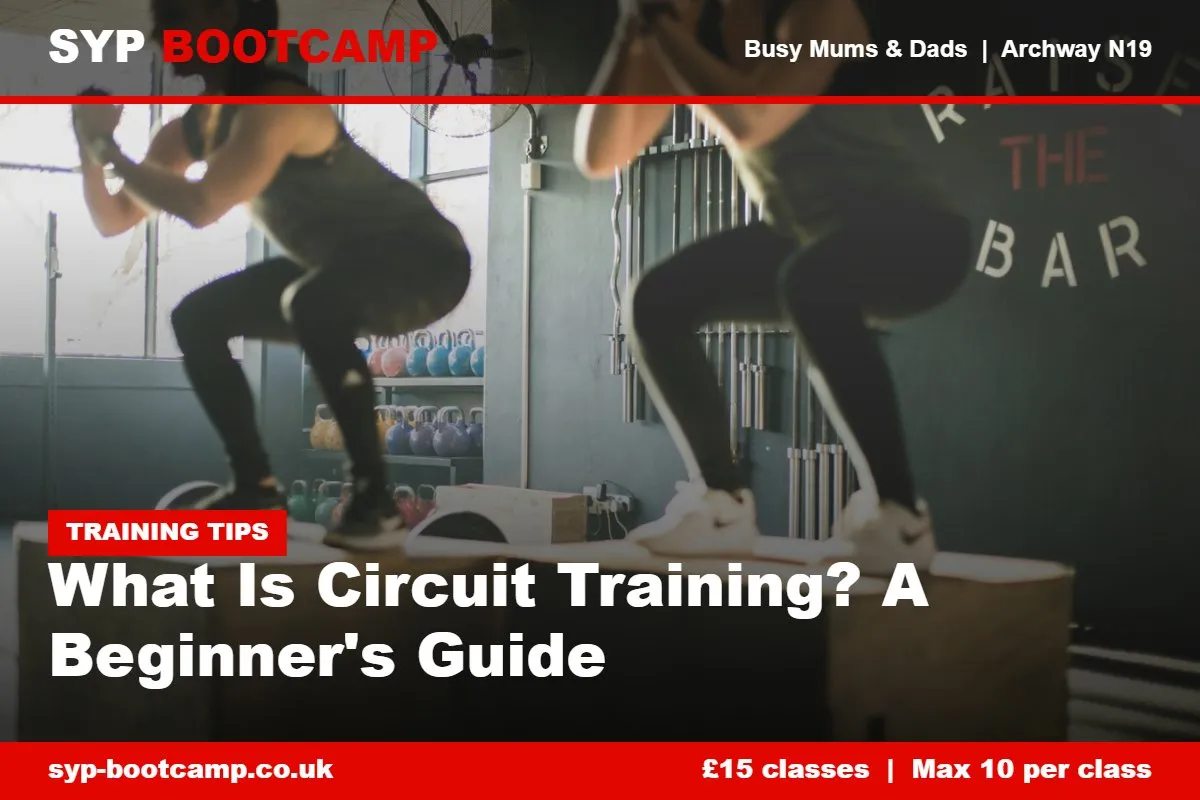
What Is Circuit Training? A Beginner's Guide
If you have ever looked at a class timetable and seen the word “circuits”, you might have pictured something out of an army film. It is much friendlier than that. So, what is circuit training? It is simply a set of exercises done one after another, with little rest in between, then repeated. For a busy mum or dad with half an hour and no plan, it is one of the most practical ways to train. Here is how it works and how to build your own today.
What is circuit training, in plain English?
A circuit is a loop of “stations”. At each station you do one exercise for a set number of reps or a set time, then move to the next. Once you finish every station, that is one round. You rest, then go again.
A typical beginner circuit might look like this:
- Squats to a chair
- Incline push-ups against a wall or worktop
- Glute bridges
- Rows with a resistance band
- Marching on the spot
That is it. Because you keep moving from one muscle group to another, the legs rest while the arms work, and vice versa. You get a strength workout with your heart rate up, in less time than doing each exercise separately with long breaks.
Why circuits suit busy parents
- It is efficient. Little wasted time between exercises.
- It covers the whole body. The NHS physical activity guidelines for adults recommend strengthening activities that work all the major muscle groups (legs, hips, back, abdomen, chest, shoulders and arms) on at least 2 days a week. A well built circuit can hit most of them in one go.
- It is easy to scale. The same circuit works for a total beginner and a fit runner. You just change the version of each exercise.
- It is hard to get bored. Every minute or so, something changes.
- It needs very little kit. Your living room, a chair and maybe a band.
How to build your first circuit (step by step)
- Warm up for 5 to 6 minutes. March on the spot, roll your shoulders, do a few slow knee bends. Easy pace, just getting warm.
- Pick 5 exercises in this order: legs, push, hips, pull, core or cardio. Alternating stops one area getting too tired.
- Set the work. Beginners: 30 seconds per exercise, or 8 to 10 reps. Move at a steady pace you can control.
- Set the rest. 15 to 30 seconds between stations to change position, then 60 to 90 seconds after each full round.
- Do 2 rounds to start. Build to 3 or 4 rounds over the next few weeks.
- Cool down. Walk around slowly for 2 to 3 minutes and let your breathing settle.
- Write it down. Rounds, reps and how it felt. Next week, try to add a round or a few reps.
Technique cues for the main moves
Squat to a chair:
- Stand just in front of a sturdy chair, feet about hip to shoulder width apart.
- Push your hips back and bend your knees, keeping your chest proud.
- Lightly touch the seat, do not flop down.
- Push through your whole foot to stand tall.
Glute bridge:
- Lie on your back, knees bent, feet flat and hip width apart.
- Gently brace your tummy as if about to cough.
- Squeeze your bum and lift your hips until your body is in a line from shoulders to knees.
- Pause for a second, then lower slowly.
Easier and harder options
- Easier: 20 seconds of work instead of 30, longer rests, wall push-ups instead of worktop, marching instead of jogging on the spot, and only 2 rounds.
- Harder: 40 seconds of work, shorter rests, squats without the chair, push-ups on a lower surface, single-leg glute bridges, and 4 rounds.
Pregnant, recently had a baby, or managing back or joint pain? Check with your GP or physio before starting, and keep everything low impact.
Circuits vs bootcamp: are they the same thing?
They overlap a lot. Most bootcamp classes use circuits as their main format, but a bootcamp usually adds partner work, intervals and a coach running the timer. If you are curious about the difference, read what is a bootcamp class, or see a full example in my sample bootcamp workout.
Where a small-group class fits
Doing circuits at home is great, but the hardest part is the planning and the motivation to start. In my SYP Bootcamp classes in Archway, the circuit is already built. There are never more than 10 people, so I can show you the easier or harder version at each station and fix your form as you go. Sessions are 45 minutes and £15. See this week’s class times on the booking page.
FAQs
How long should a circuit training session last?
For beginners, 20 to 30 minutes including the warm-up and cool-down is plenty. As you get fitter you can add rounds, but more is not always better if you are short on sleep.
Is circuit training cardio or strength?
It can be both. With heavier resistance and more rest, it leans towards strength. With lighter exercises and short rests, it gets your heart rate up more like cardio. Most circuits sit in the middle.
How often should I do circuit training?
Two or three times a week works well for most people, with a rest day or a walk in between. That also helps you meet the NHS recommendation of strength activities on at least 2 days a week.
Ready to try a circuit with a coach by your side? Book my £15 class, or WhatsApp me on 07301 512215 if you have questions first. If you would rather have every session planned around just you, take a look at private 1-1 personal training in Archway.
About the author
Artem Olekhnovych is a personal trainer in Archway and the founder of SYP Fitness and SYP Bootcamp. He has coached clients in Archway, Highgate and across North London for over 10 years, and runs small-group bootcamp classes for busy mums and dads. Read reviews from his 1-1 clients.
