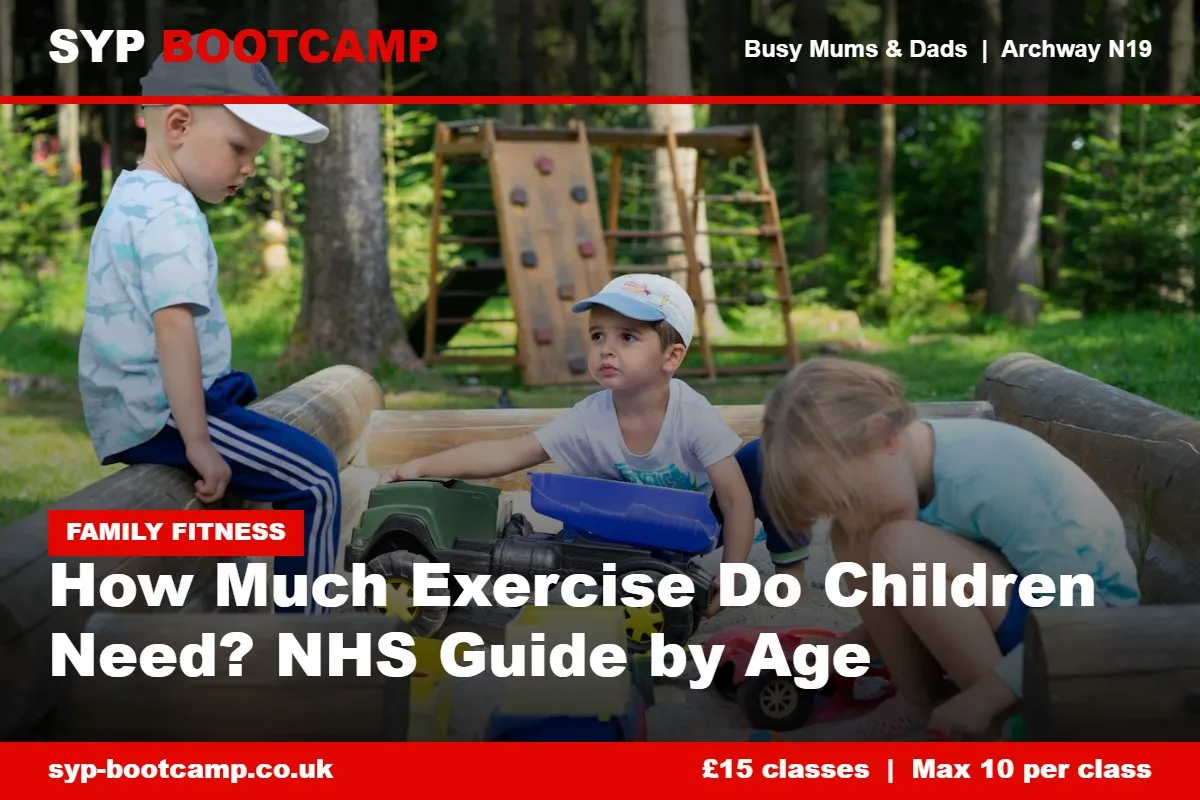
How Much Exercise Do Children Need? NHS Guide by Age
Is an hour of PE twice a week enough? Does running round the playground count? Should a four-year-old be doing “exercise” at all? If you have ever wondered how much exercise do children need, you are not alone. As a parent it is easy to feel guilty or confused, especially with screens competing for their attention. The good news is that the NHS gives clear, simple guidelines by age. Here they are in plain English, with practical ways to hit them on a normal, busy family week.
How much exercise do children need? The NHS guidelines by age
Babies (under 1)
The NHS guidelines for children under 5 say babies should be encouraged to be active throughout the day, every day, in a variety of ways, including crawling. For babies who are not yet crawling, that includes at least 30 minutes of tummy time spread through the day while they are awake, plus reaching, grasping, pulling and pushing during floor play.
Toddlers (aged 1 to 2)
Toddlers should be physically active every day for at least 180 minutes (3 hours), and the NHS says the more the better. This can be spread through the day and includes light activity such as standing up, rolling and playing, as well as more energetic things like running and jumping. Active play such as climbing frames, chasing games, ball games and water play is ideal.
Pre-schoolers (aged 3 to 4)
Pre-schoolers should spend at least 180 minutes a day doing a variety of physical activities, spread throughout the day. That should include at least 60 minutes of moderate-to-vigorous activity. The NHS also says children under 5 should not be inactive for long periods, except when asleep, and lists long stretches of watching TV, travelling by car, bus or train, or being strapped into a buggy as things to avoid.
Children and young people (aged 5 to 18)
The NHS guidelines for children and young people say they should:
- Aim for an average of at least 60 minutes of moderate or vigorous activity a day across the week.
- Take part in a variety of types and intensities of activity across the week.
- Do activities that strengthen muscles and bones.
- Reduce time spent sitting or lying down, and break up long periods of not moving.
For disabled children and young people, the NHS says to aim for 20 minutes a day, which can be split into smaller chunks.
What counts as “moderate” and “vigorous” for kids?
Parents often think exercise means a sports club. It does not. The NHS lists everyday examples of moderate activity for children such as walking to school, playground games, swimming, skipping, dancing, skateboarding, rollerblading and cycling.
For strengthening muscles and bones, the NHS gives examples such as gymnastics, football, jumping and martial arts. For young people, it also mentions sit-ups, press-ups and resistance exercises with bands or weights.
A simple test I use: if they are breathing harder and getting warm, it is moderate. If they are puffing and can only say a few words, it is vigorous.
How to fit 60 minutes into a school day
An hour can sound like a lot when you are juggling work, homework and dinner. But it adds up quicker than you think:
- School run on foot or scooter: 10 to 15 minutes each way. My post on walking the school run has tips for making it work.
- Break times and PE: active play at school counts.
- After-school park stop: 15 to 20 minutes on the climbing frame or a kickabout.
- Ten-minute burst at home: a dance-off, a game of tag in the garden, or one of the NHS Healthier Families 10 Minute Shake Up games.
Remember the NHS talks about an average across the week. A rainy Tuesday with less activity is fine if Saturday is spent at the park.
Cutting down sitting time
The guidelines are not just about adding activity. They also ask us to reduce long periods of sitting. You do not need to ban screens. Instead, try simple rules like moving at every ad break or between episodes, or a “one song dance” before tablet time. For more ideas, see my post on screen time and active families.
If your child has a health condition, disability or you are worried about their development, speak to your GP or health visitor for advice that fits them.
What about you?
Kids copy what they see. If they watch you being active, it helps make it normal. The NHS adult target is 150 minutes of moderate activity a week plus strength work on 2 or more days. SYP Bootcamp can cover a good chunk of that: 45-minute classes, indoors in Archway, a maximum of 10 people and every exercise scaled to your level. You can check this week’s class times on the booking page.
FAQs
How many minutes of exercise should a child get a day?
The NHS says children and young people aged 5 to 18 should aim for an average of at least 60 minutes of moderate or vigorous activity a day across the week. Under 5s have different guidelines, with at least 180 minutes of activity a day for toddlers and pre-schoolers.
Does PE at school count towards the 60 minutes?
Yes. The NHS Healthier Families site says activity at school, through play, cycling or sport all counts towards the daily total.
Should children do strength training?
The NHS includes muscle and bone strengthening activity in its guidelines for 5 to 18 year olds. For younger children this looks like play: jumping, climbing, gymnastics and games. Older children and teens can do press-ups, sit-ups and resistance exercises.
Book your first class
Want to model an active life for your kids while getting fitter yourself? Try a class for £15. Visit the SYP Bootcamp booking page and tap “Book my £15 class”, or call or WhatsApp me on 07301 512215. If you would like free resources to help you plan your own training, have a look at the free fitness tools from SYP Fitness.
About the author
Artem Olekhnovych is a personal trainer in Archway and the founder of SYP Fitness and SYP Bootcamp. He has coached clients in Archway, Highgate and across North London for over 10 years, and runs small-group bootcamp classes for busy mums and dads. Read reviews from his 1-1 clients.
