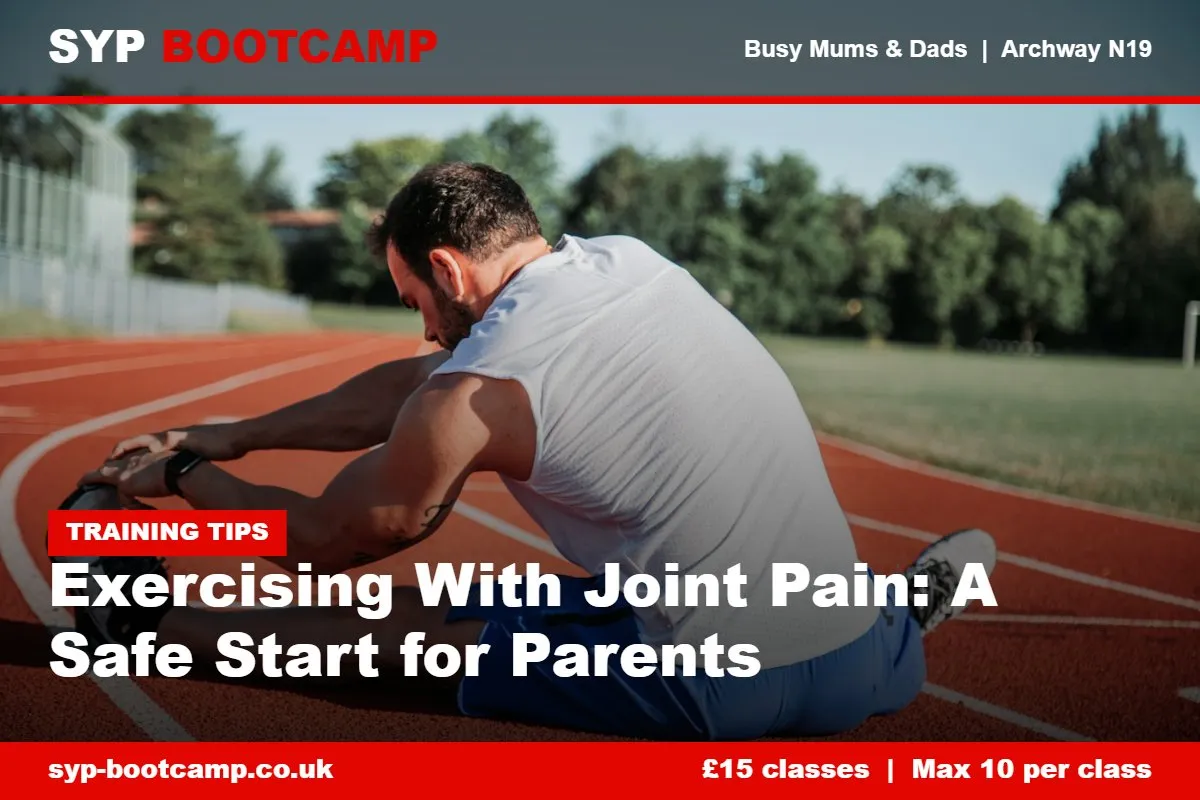
Exercising With Joint Pain: A Safe Start for Parents
Your knees ache on the stairs. Your shoulder twinges when you lift the car seat. Your hips feel stiff after a long day at your desk. When you are a busy parent with sore joints, it is tempting to think exercise is off the table until everything stops hurting. But for many people, sensible movement is part of the answer, not the problem. This guide covers exercising with joint pain in a safe, general way: what the NHS says, when to get checked first, and how to start without making things worse.
Please read this first: I am a personal trainer, not a doctor or physio. If you have joint pain, check with your GP or a physio before starting a new exercise routine, so you know what is causing it and what is safe for you.
When to get help before exercising with joint pain
The NHS joint pain page is clear about when to see someone. In summary:
- See a GP if the pain has not improved after 2 weeks of looking after it at home, or your joints are stiff for more than 30 minutes after waking up.
- Get an urgent GP appointment or call 111 if the joint is swollen and the skin around it feels hot, or you feel unwell, have a high temperature or feel hot, cold or shivery.
- Go to A&E or call 999 if you cannot walk or put weight on a joint, or the joint has moved out of place.
The NHS arthritis page also notes that in many areas you can get physiotherapy from NHS community musculoskeletal (MSK) services without a GP referral. That is worth looking into if you have been putting it off.
What the NHS says about movement and sore joints
For general joint pain, the NHS advises resting the affected joint where you can, but not completely stopping moving it. It also recommends eating a balanced diet and exercising regularly.
For osteoarthritis, the NHS treatment page says that exercise to strengthen your muscles and improve general fitness usually helps symptoms, even though people often worry it will make things worse. It also warns that doing too much too quickly, or the wrong type of exercise, could damage your joints. That is the balance we are looking for.
For arthritis more widely, the NHS suggests low impact activities such as swimming, walking, pilates and yoga.
Five principles I use with sore joints
Once you have the all-clear from a GP or physio, these are the general principles I follow with parents in my classes.
- Start lower than you think. Fewer reps, lighter weights, shorter sessions. You can always add more next week. You cannot undo a flare-up.
- Choose low impact first. Swap jumping for stepping, running for brisk walking, and burpees for a slow step-back version. You still get your heart rate up.
- Control the range. A box squat to a bench, a push-up against a wall or kitchen worktop, or a shorter lunge can all keep you training while you build up.
- Warm up properly. Five to ten minutes of easy movement before you load anything. My guide to warming up before exercise walks you through a simple routine.
- Listen to the next day. If your joint feels noticeably worse the following day, that session was probably too much. Scale back next time and tell your GP or physio if it keeps happening.
Simple swaps for common sore spots
These are general ideas, not treatment. Run them past your physio if you are unsure.
- Sore knees: sit-to-stand from a chair instead of deep squats, step-ups onto a low step instead of jump lunges, glute bridges on the floor. There is more in my post on knee-friendly workouts.
- Sore shoulders: wall push-ups, band rows and keeping weights below shoulder height for now.
- Stiff hips: walking, gentle bridges and step-ups, with long sits broken up through the day.
- Sore wrists: push-ups on your fists or on a raised surface, or swap to a band chest press.
Weight and joints
The NHS says that being overweight often makes osteoarthritis worse because it puts extra strain on some joints, and suggests losing weight through more activity and a healthier diet, ideally with advice from a GP or physio. I am not going to promise you any particular result. But if this is relevant to you, small steady changes are far easier on your joints than a crash plan.
Where a small-group class fits
Big, fast, crowded classes are not a great fit for sore joints. At SYP Bootcamp there are never more than 10 people, so I can see everyone and give you a different version of an exercise when you need it. Sessions are 45 minutes, indoors in Archway, and beginner friendly. Just tell me about your joint pain, and what your GP or physio has said, before the class starts. You can see this week’s class times on the booking page.
FAQs
Should I exercise if my joints hurt?
The NHS advises not to completely stop moving a painful joint, and says regular exercise usually helps osteoarthritis. But get it checked by your GP or a physio first, especially if the pain is new, severe or not improving after 2 weeks.
What exercise is best for joint pain?
The NHS suggests low impact activities such as swimming, walking, pilates and yoga for arthritis, along with exercises that strengthen your muscles. The best option for you depends on the cause of your pain, so ask your GP or physio.
Is it normal for joints to ache after exercise?
Some muscle soreness after a new workout is common. But if a joint feels clearly worse, swollen or hot, stop and get advice. The NHS says a joint that is swollen and hot needs an urgent GP appointment or a call to 111.
Book your first class
If your GP or physio is happy for you to exercise and you want a coach who will adapt every movement, come and try a class. It is £15, capped at 10 people and suitable for beginners. Go to the SYP Bootcamp booking page and tap “Book my £15 class”, or call or WhatsApp me on 07301 512215. If you need closer attention around a specific problem, my injury-safe personal training is built for exactly that.
About the author
Artem Olekhnovych is a personal trainer in Archway and the founder of SYP Fitness and SYP Bootcamp. He has coached clients in Archway, Highgate and across North London for over 10 years, and runs small-group bootcamp classes for busy mums and dads. Read reviews from his 1-1 clients.
